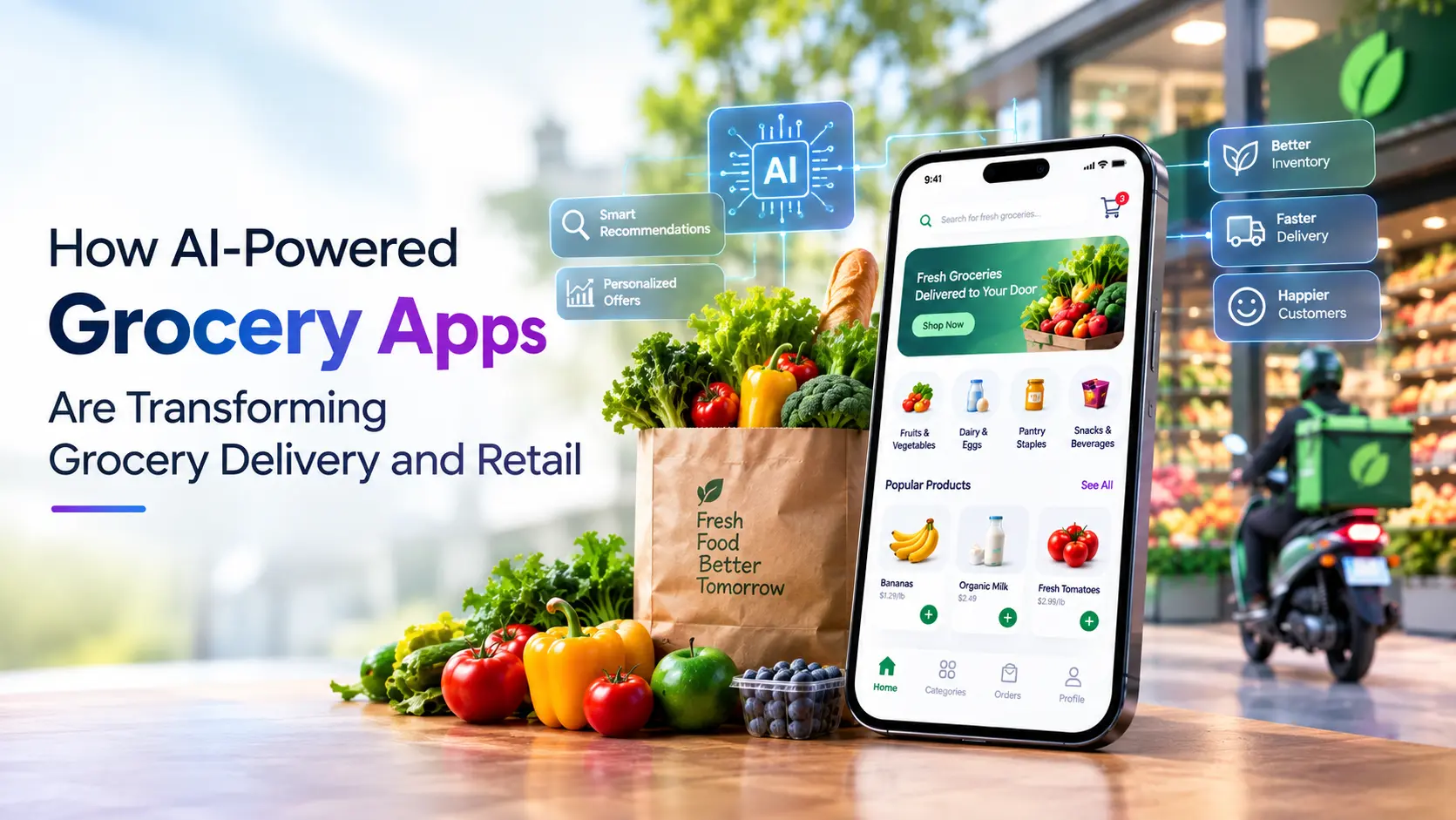
How AI-Powered Grocery Apps Are Transforming Grocery Delivery and Retail

How AI-Powered Grocery Apps Are Transforming Grocery Delivery and Retail

How AI-Powered Grocery Apps Are Transforming Grocery Delivery and Retail

Introduction: The New Era of Grocery Delivery

Grocery shopping has moved rapidly from physical stores to digital platforms. Customers now expect to browse products, compare prices, receive personalized recommendations, select delivery slots and track orders from a smartphone.

For grocery retailers, however, building a grocery delivery app is no longer simply about putting products online.

A modern grocery business needs a complete grocery ecommerce platform capable of managing products, inventory, customers, orders, payments, delivery operations and business intelligence from one connected system.

This is where AI grocery app development is becoming increasingly important.

Artificial intelligence can be integrated into a grocery delivery application to understand customer behaviour, predict demand, recommend products, identify inventory risks and improve delivery operations.

For startups and established retailers, combining Flutter app development, Laravel development and AI development can create a scalable technology foundation for modern grocery commerce.

The Biggest Problems Facing Grocery Businesses

Traditional grocery operations often involve multiple disconnected systems.

A retailer may have one system for inventory, another for online orders, a third-party payment gateway, separate delivery software and different applications for customer communication.

This creates several operational problems.

Inventory Management

Retailers need to know what products are available, what is selling quickly and which products are likely to go out of stock.
Poor inventory visibility can result in cancelled orders and dissatisfied customers.

Product Discovery

Customers can become overwhelmed when a grocery application contains thousands of products.
Simply displaying products is not enough.
The application needs intelligent search, categorisation and personalised recommendations.

Demand Forecasting

Demand can change according to:

  • Weekends
  • Holidays
  • Weather
  • Local events
  • Customer behaviour
  • Seasonal trends
  • Promotions

AI can analyse historical order data to identify these patterns.

Delivery Management

Grocery delivery requires efficient assignment of orders to drivers.
A delivery application must consider distance, delivery zones, driver availability, order priority and promised delivery time.

Customer Support

Customers frequently ask questions about:

  • Order status
  • Missing products
  • Delivery times
  • Refunds
  • Product availability
  • Substitutions

An AI-powered support assistant can automate many repetitive conversations.
 

How AI Can Improve a Grocery Delivery App

A modern grocery application can incorporate AI throughout the customer and operational journey.

  1. AI Product
    Recommendations
    The grocery app can analyse previous purchases and browsing behaviour to recommend relevant products.
    For example, if a customer regularly buys coffee, milk and cereal, the application can display relevant complementary products.
    This creates a more personalised grocery shopping experience.
  2. Intelligent Product Search:
    AI-powered search can understand natural-language queries.
    Instead of requiring a customer to search for an exact product name, the application can understand queries such as:
    “Healthy breakfast items under ₹500.”
    The system can return relevant products based on category, price and customer preferences.
  3. AI Demand Forecasting
    Machine learning models can analyse historical orders and identify potential demand patterns.
    This can help grocery businesses plan inventory more effectively.
    The system could identify:
    • High-demand products
    • Seasonal products
    • Slow-moving inventory
    • Potential stock shortages
    • Regional demand
  4. Intelligent Product Substitution
    When a product is unavailable, AI can recommend suitable alternatives.
    For example:
    Product unavailable → Recommend similar brand → Similar size → Similar price
    This can reduce lost sales caused by stock shortages.
  5. AI Delivery Assignment
    AI can help determine which driver should receive an order based on:
    • Driver location
    • Delivery distance
    • Current workload
    • Delivery zone
    • Vehicle type
    • Order priority

This can be integrated into a grocery delivery management dashboard.

Flutter + Laravel for Grocery App Development

For businesses looking for scalable grocery app development, Flutter and Laravel provide a strong application architecture.
Flutter can be used to develop:

  • Customer mobile applications
  • Driver applications
  • Store applications
  • Admin applications

Laravel can power:

  • APIs
  • Authentication
  • Product management
  • Order management
  • Inventory
  • Payments
  • Promotions
  • Customer management
  • Delivery management


"The best architecture is one your team can fully understand, debug at 2am, and evolve without fear. Complexity is a liability, not a feature."
— Daniel Osei, Platform Architect at Crayola Digital

// OrderStateMachine.php
class OrderStateMachine {
const TRANSITIONS = [
‘pending’ => [‘confirmed’, ‘cancelled’],
‘confirmed’ => [‘preparing’, ‘cancelled’],
‘preparing’ => [‘ready’, ‘failed’],
‘ready’ => [‘dispatched’],
‘dispatched’ => [‘delivered’, ‘failed’],
];
public function transition(Order $order, string $to): bool {
$allowed = self::TRANSITIONS[$order->status] ?? [];
if (!in_array($to, $allowed)) return false;
return DB::transaction(fn() => $order->update([‘status’ => $to]));
}
}

This pattern ensures that invalid state transitions are caught at the application layer before they ever hit the database, reducing the need for complex compensating transactions.

Results & Learnings

Across six client deployments using this architecture over the past 18 months, we've observed consistent improvements in both engineering velocity and platform reliability:

Uptime across all deployments

0 %

Average cost-per-delivery reduction

0 %

Faster feature delivery vs. monolith

0 x

The most consistent finding: teams that invest in a solid state machine and event bus in the first sprint ship twice as fast in months three through twelve. The upfront cost pays off within weeks.

Amir Hassan

Amir is Lead Flutter Engineer at Crayola Digital with 6+ years building cross-platform apps, recently focused on integrating LLM-powered UX into mobile products.

Share your thoughts

Have questions or feedback? We'd love to hear from the community.

Contents

Need help building your app?

We ship Flutter, Laravel, and AI-powered platforms end-to-end.

Ready to build your platform?

Our team ships production-grade delivery and AI apps. Let's talk about your project.

Hello World

Hello World

portfolio-img1

The global on-demand delivery market crossed $500 billion in 2024, and the platforms powering that growth are more technically demanding than ever. Whether you're building a grocery app, a dark kitchen ordering system, or a multi-vendor marketplace, the technology choices you make in year one will either accelerate or constrain you for the next decade.

In this article we'll break down the architectural decisions, technology selections, and implementation patterns that our engineering team has refined across 40+ delivery platform builds. We'll use real numbers from production deployments — not theoretical benchmarks.

The Core Challenge

Delivery platforms face a uniquely hostile performance environment. You have three concurrent audiences — customers, drivers, and merchants — each with different latency tolerances, data freshness requirements, and interaction patterns. A customer browsing menus can tolerate a 200ms page load. A driver receiving a new job assignment cannot tolerate a 30-second delay. A merchant watching their live order queue needs sub-second updates.

  • Real-time location tracking across thousands of concurrent drivers
  • Order state machines with complex branching logic and rollback scenarios
  • Multi-region database replication to minimise query latency
  • Payment processing with PCI-DSS compliance and fraud detection
  • Push notification delivery with guaranteed at-least-once semantics

Solution Architecture

After dozens of iterations, we've converged on a layered architecture that separates concerns cleanly while remaining operable by a team of four to eight engineers. The key insight is that not every service needs to be microserviced — premature decomposition creates operational overhead that kills velocity at small scale.

"The best architecture is one your team can fully understand, debug at 2am, and evolve without fear. Complexity is a liability, not a feature."
— Daniel Osei, Platform Architect at Crayola Digital

Implementation

Here's the core order state machine implementation pattern we use in Laravel, which handles the full lifecycle from placement through delivery confirmation with built-in rollback support:

// OrderStateMachine.php
class OrderStateMachine {
const TRANSITIONS = [
‘pending’ => [‘confirmed’, ‘cancelled’],
‘confirmed’ => [‘preparing’, ‘cancelled’],
‘preparing’ => [‘ready’, ‘failed’],
‘ready’ => [‘dispatched’],
‘dispatched’ => [‘delivered’, ‘failed’],
];
public function transition(Order $order, string $to): bool {
$allowed = self::TRANSITIONS[$order->status] ?? [];
if (!in_array($to, $allowed)) return false;
return DB::transaction(fn() => $order->update([‘status’ => $to]));
}
}

This pattern ensures that invalid state transitions are caught at the application layer before they ever hit the database, reducing the need for complex compensating transactions.

Results & Learnings

Across six client deployments using this architecture over the past 18 months, we've observed consistent improvements in both engineering velocity and platform reliability:

Uptime across all deployments

0 %

Average cost-per-delivery reduction

0 %

Faster feature delivery vs. monolith

0 x

The most consistent finding: teams that invest in a solid state machine and event bus in the first sprint ship twice as fast in months three through twelve. The upfront cost pays off within weeks.

Amir Hassan

Amir is Lead Flutter Engineer at Crayola Digital with 6+ years building cross-platform apps, recently focused on integrating LLM-powered UX into mobile products.

Share your thoughts

Have questions or feedback? We'd love to hear from the community.

Contents

Need help building your app?

We ship Flutter, Laravel, and AI-powered platforms end-to-end.

Ready to build your platform?

Our team ships production-grade delivery and AI apps. Let's talk about your project.