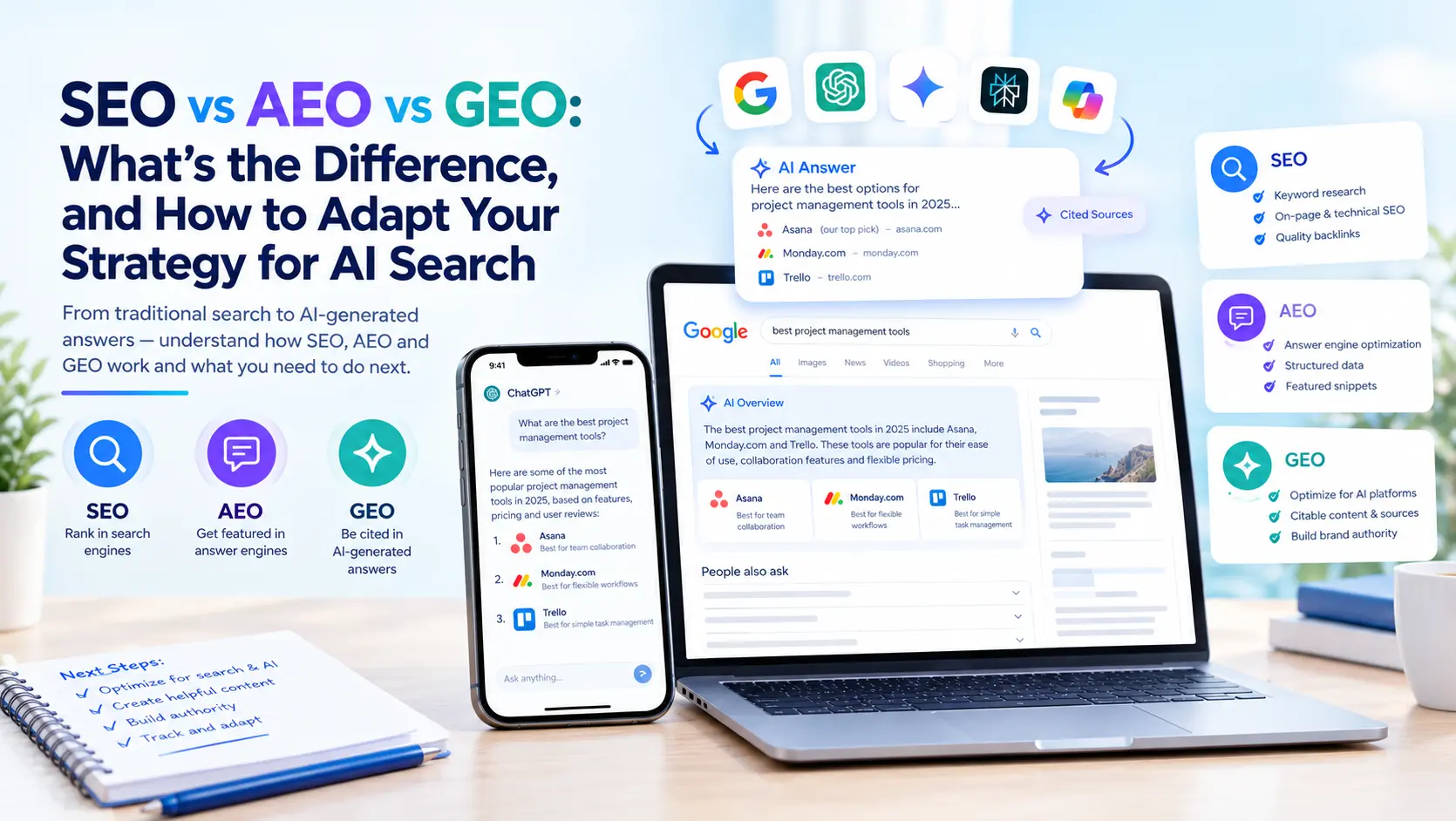
Search is no longer just ten blue links. People now get synthesized answers from Google AI Overviews, ChatGPT, Gemini, Perplexity and Copilot, and many of those answers recommend brands directly. That has created two new acronyms, AEO and GEO, alongside traditional SEO. In this guide, Crayola Digital explains how SEO, answer engine optimization (AEO) and generative engine optimization (GEO) differ, where they overlap, and what to do about each.
Quick Definitions: SEO, AEO and GEO
What Is SEO?
Search engine optimization is the practice of improving your website so it ranks in search engine results, through technical health, relevant content, authority signals such as links, and a good user experience. The goal is organic visibility and traffic.
What Is AEO (Answer Engine Optimization)?
Answer engine optimization is the practice of structuring content so it can be selected as the direct answer to a specific question. That includes featured snippets, People Also Ask boxes, voice assistants and AI answer panels. The goal is to be the answer, not just a link.
What Is GEO (Generative Engine Optimization)?
Generative engine optimization is the practice of improving how often and how accurately your brand and content appear in answers generated by AI systems such as ChatGPT, Gemini, Perplexity, Copilot and Google AI Overviews. The goal is to be cited, mentioned and recommended.
SEO vs AEO vs GEO: Side-by-Side Comparison
| Provider | SEO | AEO | GEO |
|---|---|---|---|
Primary goal | Rank pages and earn clicks | Provide the direct answer to a question | Be cited and recommended in AI-generated responses |
Typical surfaces | Search results pages | Featured snippets, People Also Ask, voice assistants, answer boxes | AI assistants and AI-generated summaries |
Query style | Short keywords and phrases | Specific questions | Conversational, multi-part and comparison prompts |
Content approach | Keyword-targeted pages | Concise, answer-first, structured content | Clear, quotable, evidence-backed content and strong entity signals |
Authority signals | Links, expertise, reputation | Trusted, well-structured sources | Brand mentions, citations, consistent information across the web |
Key metrics | Rankings, traffic, conversions | Snippet wins, answer placements | Citations, mentions, share of voice, sentiment |
Predictability | Relatively stable, trackable | Moderate | Variable, since AI answers differ by prompt, user and time |
The most important point is that these are layers, not rivals. AEO and GEO sit on top of SEO.
Does SEO Still Matter in the Age of AI Search?
Yes. AI systems that answer questions from the web depend on content that can be crawled, understood and trusted. Pages that are accessible, well organized, credible and useful are the ones most likely to be used as sources. Google has also said that its AI features draw on the same foundations as its core search system, so basic SEO health remains important.
What changes is the definition of success. Ranking number one still matters, but so does:
- Whether your content is chosen as a source in an AI answer
- Whether your brand is mentioned when someone asks for recommendations
- Whether the description of your brand is accurate
SEO gets you into the pool of sources. AEO and GEO help you get selected from it.
Why AEO and GEO Matter Now
Zero-Click Behavior Is Rising
More searches are answered directly on the results page or inside an assistant, so users get what they need without visiting a site. Visibility now includes appearing within the answer.
Buyers Use AI for Research and Shortlisting
Prospects increasingly ask AI tools questions like "what's the best software for X?" or "compare these providers." If your brand isn't part of those answers, you may never reach the consideration stage.
Queries Are Becoming Longer and More Conversational
People describe their full situation instead of typing two keywords. Content that addresses real, specific questions in natural language is better suited to these queries.
Early Mover Advantage
Many competitors haven't adapted. Brands that build clear entity signals and a record of trusted, citable content now can establish a lasting lead in their category.
How to Optimize for AEO: Practical Steps
- Find real questions.
Use search suggestions, People Also Ask, sales and support conversations, and community forums to identify the questions your audience actually asks. - Lead with the answer.
Put a clear, direct answer in the first sentence or two under a question-style heading, then add detail, examples and evidence. - Use clean structure.
Use descriptive headings, short paragraphs, lists for steps, tables for comparisons and definitions that stand on their own. - Add structured data.
Use schema markup, such as FAQPage, HowTo where appropriate, Organization, Product and Article, to describe content accurately. Keep it consistent with the visible page. Note that Google has reduced the visibility of some FAQ and HowTo rich results, so treat schema as a clarity aid and not a guaranteed display feature. - Cover topics in depth.
Build clusters of related content so you demonstrate real topical expertise, not one-off answers. - Keep content fresh and accurate.
Update key pages and show clear dates and authorship.
How to Optimize for GEO: Practical Steps
- Make Your Brand an Unambiguous Entity
AI systems reason about entities such as brands, products and people. Use consistent names, descriptions and facts across your website, social profiles, business listings and directories. Maintain clear About, Author and Service pages, and use Organization schema with accurate `sameAs` links. - Publish Content That Is Easy to Quote
Include clear definitions, original data, expert commentary, specific facts and balanced comparisons. Content that adds something new, such as first-hand experience, proprietary research or detailed examples, is more useful to cite than generic summaries. - Build Credible Third-Party Mentions
AI-generated answers often reflect what the wider web says about you. Earn coverage through digital PR, expert contributions, industry publications, reviews, partnerships and communities where your audience discusses your category. Focus on genuine authority, not volume. - Be Present Where AI Systems Look
Different systems draw on different sources. Make sure you have a presence on relevant review platforms, directories, professional communities and reference sites for your industry, and keep your information accurate there. - Ensure Technical Accessibility
Check that important pages are crawlable, load quickly, render properly and are not blocked unintentionally. Review robots directives for both search crawlers and AI-related crawlers, and decide which to allow based on your goals and how you want your content used. - Create Comparison and Evaluation Content
Many AI prompts ask for "best," "vs" and "alternatives." Publish fair, evidence-based comparison pages, buyer's guides and use-case content that help evaluators and give AI systems solid material. - Be Cautious With Unproven Tactics
New conventions, such as proposed files for AI crawlers, may or may not be used by any given system. It is reasonable to implement low-cost items, but don't rely on them or buy services that promise guaranteed placement. No one controls what an AI system says.
How to Measure AEO and GEO
Measurement is harder than in traditional SEO, because AI answers vary. A reliable approach:
- Create a fixed prompt set
of 20 to 50 buyer-style questions covering awareness, comparison and decision stages. - Run it on a schedule
across the AI platforms your audience uses, and record results. - Track mentions and citations:
whether you appear, how often, and which pages are cited. - Measure share of voice
against named competitors. - Check accuracy and sentiment:
is the description of your brand correct and favorable? - Review referral traffic
from AI platforms where your analytics can identify it.
- **Watch conventional metrics:** rankings, snippet wins, conversions and branded search trends.
Look at trends over weeks, not individual screenshots, because a single answer can differ the next time it is generated.
A Practical Roadmap: Moving From SEO to AEO and GEO
You don't need a rebuild. A staged approach works well:
1. **Baseline.** Audit your current SEO health and test how AI tools describe your brand.
2. **Prioritize.** Choose the commercial topics and questions that matter most.
3. **Restructure.** Rewrite priority pages in an answer-first format with clear headings and evidence.
4. **Strengthen entities.** Fix inconsistent brand data and add schema.
5. **Build authority.** Earn mentions and citations from credible sources.
6. **Measure and expand.** Track visibility, then extend what works to more topics.
For help running this process, see our [generative engine optimization services](/generative-engine-optimization-services/).
When to Hire an ASO Agency
Doing ASO in-house is possible, but an agency helps when you:
- Lack the time, tools or experience for continuous keyword and creative testing
- Are launching a new app and need a strong start
- Have plateaued downloads or rising acquisition costs
- Manage multiple apps or markets
- Want ASO and paid campaigns coordinated
Choose a partner who is transparent about methods, reports on installs and conversion, and does not guarantee rankings or download counts, since the stores control their own algorithms.
Frequently Asked Questions (FAQs)
ASO is the process of improving an app's visibility in app store search and its listing conversion rate, using keywords, metadata, creatives, ratings and testing.
Conversion changes from new creatives can show results within weeks. Keyword ranking improvements typically build over two to three months or longer, depending on competition.
Yes. Each store indexes different fields, has different character limits and offers different testing tools. Apple has a hidden keyword field, while Google Play indexes the long description.
No. ASO drives organic growth and improves paid performance, while paid campaigns add scale and speed. The two work best together.
Review keywords and performance monthly, test creatives continuously, and update metadata when you add features, enter new markets or see ranking shifts.
Ratings strongly influence conversion and are widely considered a ranking factor. A better average rating and more recent reviews build user trust.
Cost depends on whether you need a one-time audit, a monthly retainer or a full growth program. Contact Crayola Digital for a custom estimate.
Ready to Grow Your App Downloads?
Strong ASO turns your store listing into your best acquisition channel. Crayola Digital offers audits, keyword optimization, creative testing and full-funnel app marketing for iOS and Android.
Contents
Need help building your app?
Book a free consultation with Crayola Digital and get a custom fleet tracking roadmap.