Introduction: The New Era of Grocery Delivery
Grocery shopping has moved rapidly from physical stores to digital platforms. Customers now expect to browse products, compare prices, receive personalized recommendations, select delivery slots and track orders from a smartphone.
For grocery retailers, however, building a grocery delivery app is no longer simply about putting products online.
A modern grocery business needs a complete grocery ecommerce platform capable of managing products, inventory, customers, orders, payments, delivery operations and business intelligence from one connected system.
This is where AI grocery app development is becoming increasingly important.
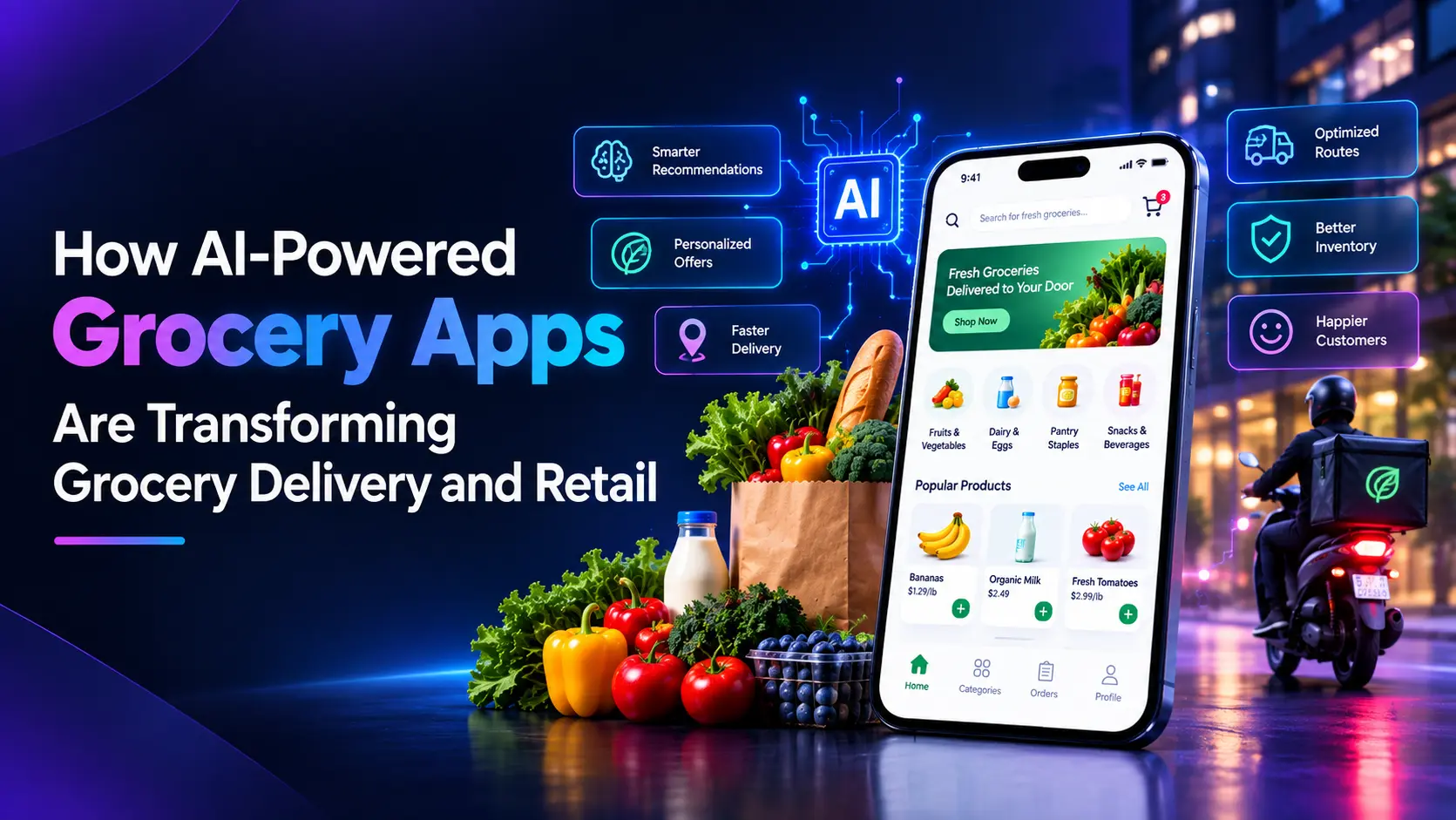
Artificial intelligence can be integrated into a grocery delivery application to understand customer behaviour, predict demand, recommend products, identify inventory risks and improve delivery operations.
For startups and established retailers, combining Flutter app development, Laravel development and AI development can create a scalable technology foundation for modern grocery commerce.
The Biggest Problems Facing Grocery Businesses
Traditional grocery operations often involve multiple disconnected systems.
A retailer may have one system for inventory, another for online orders, a third-party payment gateway, separate delivery software and different applications for customer communication.
This creates several operational problems.
Inventory Management
Retailers need to know what products are available, what is selling quickly and which products are likely to go out of stock.
Poor inventory visibility can result in cancelled orders and dissatisfied customers.
Product Discovery
Customers can become overwhelmed when a grocery application contains thousands of products.
Simply displaying products is not enough.
The application needs intelligent search, categorisation and personalised recommendations.
Demand Forecasting
Demand can change according to:
- Weekends
- Holidays
- Weather
- Local events
- Customer behaviour
- Seasonal trends
- Promotions
AI can analyse historical order data to identify these patterns.
Delivery Management
Grocery delivery requires efficient assignment of orders to drivers.
A delivery application must consider distance, delivery zones, driver availability, order priority and promised delivery time.
Customer Support
Customers frequently ask questions about:
- Order status
- Missing products
- Delivery times
- Refunds
- Product availability
- Substitutions
An AI-powered support assistant can automate many repetitive conversations.
How AI Can Improve a Grocery Delivery App
A modern grocery application can incorporate AI throughout the customer and operational journey.
- AI Product
Recommendations
The grocery app can analyse previous purchases and browsing behaviour to recommend relevant products.
For example, if a customer regularly buys coffee, milk and cereal, the application can display relevant complementary products.
This creates a more personalised grocery shopping experience. - Intelligent Product Search:
AI-powered search can understand natural-language queries.
Instead of requiring a customer to search for an exact product name, the application can understand queries such as:
“Healthy breakfast items under ₹500.”
The system can return relevant products based on category, price and customer preferences. - AI Demand Forecasting
Machine learning models can analyse historical orders and identify potential demand patterns.
This can help grocery businesses plan inventory more effectively.
The system could identify:- High-demand products
- Seasonal products
- Slow-moving inventory
- Potential stock shortages
- Regional demand
- Intelligent Product Substitution
When a product is unavailable, AI can recommend suitable alternatives.
For example:
Product unavailable → Recommend similar brand → Similar size → Similar price
This can reduce lost sales caused by stock shortages. - AI Delivery Assignment
AI can help determine which driver should receive an order based on:- Driver location
- Delivery distance
- Current workload
- Delivery zone
- Vehicle type
- Order priority
This can be integrated into a grocery delivery management dashboard.
Flutter + Laravel for Grocery App Development
For businesses looking for scalable grocery app development, Flutter and Laravel provide a strong application architecture.
Flutter can be used to develop:
- Customer mobile applications
- Driver applications
- Store applications
- Admin applications
Laravel can power:
- APIs
- Authentication
- Product management
- Order management
- Inventory
- Payments
- Promotions
- Customer management
- Delivery management
AI services can then be integrated using Python-based machine learning services or external AI APIs.
This creates a modular architecture where the business can introduce AI gradually instead of rebuilding the entire grocery platform.
Out-of-the-Box AI Features for Grocery Businesses
Businesses can go beyond basic recommendations.
AI Grocery Business Assistant
Management could ask:
“Which products had the highest sales this weekend?”
or:
“Which stores are likely to experience stock shortages?”
The AI assistant can retrieve information from authorised business systems and provide an operational answer.
Customer Churn Prediction
AI can identify customers whose ordering frequency is declining.
The marketing team can then create targeted campaigns.
Store-Level Intelligence
For multi-store grocery businesses, AI can compare:
- Store sales
- Product performance
- Delivery performance
- Customer behaviour
- Inventory patterns
This creates a centralised retail intelligence platform.
Why Custom Grocery App Development Matters
Every grocery business operates differently.
A supermarket chain, dark store, local grocery startup and multi-vendor marketplace may require completely different workflows.
A custom grocery delivery application can therefore be designed around the company's actual business model.
Crayola Digital can combine Flutter mobile app development, Laravel backend development, Python AI development and API integration to create customised grocery technology platforms.
Frequently Asked Questions
AI grocery app development involves integrating artificial intelligence and machine learning into grocery applications to improve recommendations, forecasting, customer support, inventory management and operational decision-making.
The cost depends on the number of applications, features, integrations, design requirements, backend architecture and AI functionality. A focused MVP is usually significantly less expensive than a full multi-store grocery ecosystem.
Yes. Flutter can be used to build customer, driver, store and administration applications from a shared technology stack.
Laravel can be used to develop APIs, authentication, product management, orders, inventory, payments and administration functionality.
AI and machine learning models can analyse historical business data to identify demand patterns and generate forecasts.
Yes. AI capabilities can often be introduced through APIs or separate Python-based services without rebuilding the entire application.
Build Your AI-Powered Grocery Platform
If you are planning a grocery delivery startup, supermarket application, multi-store grocery marketplace or retail technology platform, the right architecture can make future expansion much easier.
Crayola Digital works across Flutter app development, Laravel development, Python AI development, AI agents and API integrations to build scalable digital products for grocery and retail businesses.
Planning a grocery delivery application? Let's discuss your product idea, MVP scope and AI opportunities.
Also explore our related Blog:
Contents
Need help building your app?
We ship Flutter, Laravel, and AI-powered platforms end-to-end.